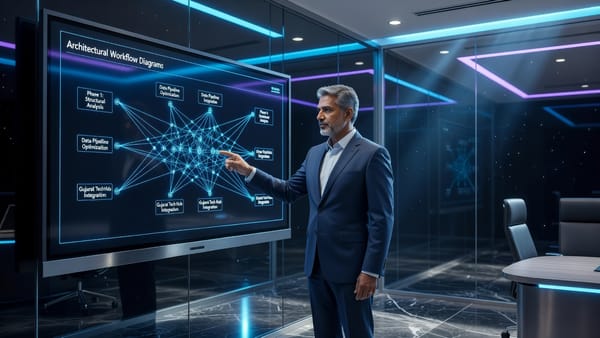



You sit at your desk late at night, staring at a flashing cursor while a dozen Slack notifications remind you that your competitors have already rolled out automated workflows you haven't even mapped yet. It is the familiar, sinking feeling of watching the tech landscape shift beneath your feet while your own internal team struggles to agree on a basic software stack. Before you panic and buy another off-the-shelf software license, pause for a moment and listen to what twenty-five years in the trenches of the tech industry has taught me about surviving these moments.
After working through this with dozens of clients across Gujarat and international markets, what nobody tells you is that your biggest bottleneck isn't your engineering capacity or your cloud budget. It is the invisible friction between visionary ambition and daily operational reality. When we look at how global giants like Microsoft and Google orchestrate massive technological pivots, their success has very little to do with raw compute power and everything to do with resilient leadership frameworks. In 2025, artificial intelligence has evolved from an experimental sandbox into a boardroom mandate, yet many organizations still treat machine learning adoption like a plug-and-play printer installation.
The Shifting Paradigm of Enterprise Technology
The corporate landscape has undergone a seismic shift over the past twenty-four months, moving away from decentralized tool experimentation toward deeply integrated, autonomous agent ecosystems. According to Gartner, over 80 percent of enterprises have integrated generative artificial intelligence APIs into production environments, a staggering leap from less than 5 percent just a few years ago. Yet, despite this massive surge in adoption, a significant percentage of these enterprise initiatives fail to deliver their anticipated return on investment because executives treat technology as a magic bullet rather than an organizational evolution. When I advise startup founders and enterprise executives, I always emphasize that building a tech-forward culture requires balancing visionary ambition with pragmatic execution. We cannot simply delegate machine learning adoption to our engineering departments and expect immediate productivity gains without addressing human readiness.
Leadership in the age of intelligent automation requires an intimate understanding of data governance, security protocols, ethical implications, and change management. Tools provided by pioneers like Salesforce and enterprise cloud ecosystems managed via AWS provide incredible operational velocity, but without deliberate human oversight, they simply amplify existing operational dysfunctions at scale. According to McKinsey, companies that couple digital investments with rigorous cultural alignment achieve nearly triple the financial returns of their peers who focus purely on software procurement. This reality forces us to rethink how we structure our internal teams, bridge communication gaps between non-technical departments and core engineering squads, and establish clear ethical guardrails for automated decision-making.

Core Pillars for Scaling Intelligent Operations
To move past the paralysis of complex tool selection, leaders need a structured mental model that bridges the gap between high-level strategy and daily execution. Over years of trial and error in leading global initiatives, I developed a four-pillar framework that I consistently use to evaluate new technological bets and guide engineering teams. This model ensures that every dollar spent on innovation directly contributes to measurable business outcomes without alienating internal teams or compromising data security. The first pillar is operational clarity, which requires auditing your current workflows before introducing any automated tools or large language models.
Technology amplifies intent. If your internal processes are broken, throwing advanced algorithms at them will only break things faster and more expensively.
The second pillar is experimental agility, heavily inspired by modern agile practices found on GitHub and GitLab, allowing teams to prototype, test, and fail quickly in sandboxed environments. The third pillar focuses on continuous upskilling, ensuring that non-technical departments understand the capabilities and limitations of the tools they use daily. Finally, the fourth pillar centers on ethical accountability, establishing clear boundaries for data privacy and algorithmic bias, a mandate supported by recent insights from Harvard Business Review. When a mid-sized financial services firm approached our advisory practice last year with an overwhelmed customer support pipeline, we didn't immediately buy an off-the-shelf chatbot solution from OpenAI. Instead, we audited their fragmented document storage across disparate cloud buckets, implemented secure retrieval-augmented generation connected to their internal databases, and empowered support staff with instant, accurate answers while keeping sensitive customer data entirely secure.
Practical Implementation and Benchmarking Success
To put this framework into perspective, let us examine how different strategic approaches impact enterprise transformation metrics across key performance indicators compiled from recent industry benchmarks and organizational case studies. Measuring success in an AI-first organization requires looking beyond traditional vanity metrics like software license counts and focusing on true adoption velocity, error reduction, and cross-functional alignment.
Implementing these metrics requires disciplined patience. We must resist the temptation to adopt every shiny new framework that trends on Twitter/X or LinkedIn. True strategic vision lies in knowing what to ignore so your engineering and business teams can focus entirely on initiatives that drive sustainable, long-term competitive advantage in the global market. Open your project management software-whether you utilize Notion, Asana, or Trello-and schedule a mandatory two-hour operational audit with your core leadership team within the next 24 hours to map recurring workflows and identify your top two bottlenecks.
As you continue exploring digital transformation and leadership strategies for your enterprise, I encourage you to evaluate your current data governance protocols and start a conversation with your engineering leads this week about workflow friction points. Let us build smarter, more resilient organizations together.