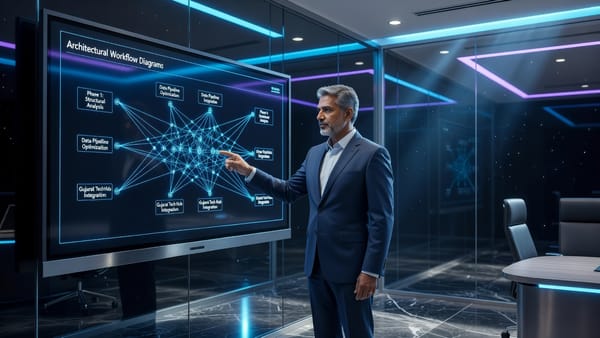



We deployed a heavily fine-tuned, proprietary machine learning model across our core operations, assuming that technical superiority alone would guarantee rapid user adoption and immediate productivity gains. We made the classic mistake of focusing entirely on the underlying algorithms while completely ignoring the human friction points, operational workflows, and cultural readiness of our teams. The deployment stalled, engineering morale plummeted, and our clients questioned the tangible value of the entire initiative. That expensive miscalculation forced me to completely rethink how we approach artificial intelligence implementation, shifting my perspective from chasing raw technical complexity to aligning technology directly with human capability and operational reality.
Reflecting on my twenty-five years in the trenches of the tech industry, spanning from my early engineering days to leading enterprises right here in Gujarat and collaborating with partners across the globe, I realized that true digital transformation is rarely about the code. When we look at how global giants like Microsoft, Google, and IBM orchestrate their technological roadmaps, their success hinges less on raw compute power and more on resilient leadership frameworks. The intersection of modern innovation, leadership advocacy, and social change in India demands a radical departure from rigid legacy management into a more experimental, supportive, and demanding ecosystem.

The Evolution of AI Leadership in Modern Business
As we navigate through 2025, the corporate landscape is witnessing a seismic shift driven by advanced machine learning, cloud infrastructure, and autonomous agent frameworks. According to Gartner, over 80 percent of enterprises will have integrated generative artificial intelligence APIs or deployed genAI applications in production environments, up from less than 5 percent just a few years ago. Yet, despite this massive surge in adoption, a significant percentage of these enterprise initiatives fail to deliver their anticipated return on investment because executives treat technology as a plug-and-play utility rather than a fundamental organizational evolution.
When I advise startup founders and enterprise executives, I always emphasize that building a tech-forward culture requires balancing visionary ambition with pragmatic execution. We cannot simply delegate machine learning adoption to our engineering departments and expect magic. Leadership in the age of intelligent automation requires an intimate understanding of data governance, security protocols, ethical implications, and change management. Tools provided by pioneers like Salesforce and enterprise ecosystems managed via AWS or Azure provide incredible velocity, but without deliberate human oversight, they simply amplify existing operational dysfunctions at scale.
Technology amplifies intent. If your internal processes are broken, throwing advanced algorithms at them will only break things faster and more expensively.
A Practical Framework for Scaling Intelligent Enterprises
To move past the paralysis of complex tool selection, leaders need a structured mental model that bridges the gap between high-level strategy and daily execution. Over the years of trial and error, I developed a four-pillar framework that I consistently use to evaluate new technological bets and guide our global engineering initiatives. This model ensures that every dollar spent on innovation directly contributes to measurable business outcomes without alienating internal teams or compromising security.
The first pillar is operational clarity, which requires auditing your current workflows before introducing any automated tools or large language models. The second pillar is experimental agility, heavily inspired by modern agile practices found on GitHub and GitLab, allowing teams to prototype, test, and fail quickly in sandboxed environments. The third pillar focuses on continuous upskilling, ensuring that non-technical departments understand the capabilities and limitations of the tools they use daily. Finally, the fourth pillar centers on ethical accountability, establishing clear boundaries for data privacy and algorithmic bias, a mandate heavily supported by recent insights from McKinsey.
To put this framework into perspective, let us examine how different strategic approaches impact enterprise transformation metrics across key performance indicators compiled from recent industry benchmarks and organizational case studies.
Case Study: Transforming Legacy Operations with Intelligent Automation
Consider the transformation journey of a mid-sized financial services firm that approached our advisory practice last year. Their customer support pipeline was entirely overwhelmed by manual inquiry routing, leading to delayed response times and declining customer satisfaction scores. Instead of immediately purchasing an off-the-shelf chatbot solution from vendors like OpenAI or Anthropic, we initiated a comprehensive audit of their internal knowledge bases and customer interaction patterns.
We discovered that their primary bottleneck was not the speed of communication, but the fragmented storage of regulatory documents across disparate cloud storage buckets. By implementing a hybrid architecture utilizing secure retrieval-augmented generation connected to their internal SAP and Oracle databases, we empowered support staff with instant, accurate answers while keeping sensitive customer data entirely secure. According to research published by Harvard Business Review, enterprises that prioritize data integration before deploying generative interfaces see a threefold increase in employee productivity compared to those that rush into tool implementation without preparatory architecture.
This case study reinforced my belief that successful technology leadership is an exercise in disciplined patience. We must resist the temptation to adopt every shiny new framework that trends on Twitter/X or LinkedIn. True strategic vision lies in knowing what to ignore so your engineering and business teams can focus entirely on initiatives that drive sustainable, long-term competitive advantage in the global market.
Your Action Plan for Immediate Impact
To transform these strategic insights into tangible results, you need a concrete execution plan that requires zero procrastination. Open your project management software-whether you utilize Notion, Asana, or Trello-and schedule a mandatory two-hour operational audit with your core leadership team within the next 24 hours. During this session, map out every single recurring workflow in your department, identify the top two operational bottlenecks causing friction, and document one specific experiment you can launch next week using existing tools to resolve them.