



According to research from IBM, fewer than one in five organizations keep a complete, current inventory of their operational artificial intelligence systems. That statistic should terrify every enterprise leader, because if you do not know which autonomous agents are querying your databases, committing code, and placing warehouse replenishment orders, you are running an organization compromised by silent operational drift. When four out of five businesses operate blind across their algorithmic landscape, the conversation can no longer center on prompt engineering or agent generation.
For the past sixteen years, my work across the industrial manufacturing hubs of Abu Dhabi and Dubai has concentrated on complex automated telemetry, industrial robotics, and systems integration under the UAE's Operation 300bn initiative. In the early stages of this autonomous wave, I made the classic mistake that I see countless Chief Technology Officers repeating today: I treated autonomous agents as isolated bespoke projects rather than persistent industrial infrastructure. We celebrated how rapidly our engineering teams could deploy autonomous workflow units, while completely neglecting the operational machinery required to supervise them over time.
The Proliferation Trap: Why AI Agent Estate Management Is Failing
The global technology sector has spent the last two years obsessing over creation platforms. Systems integrators and internal IT departments have raced to assemble agents using frameworks from multiple disparate providers, inadvertently creating a fragmented shadow IT crisis of historic proportions. On September 25, 2026, enterprise platform provider Dataiku addressed this systemic vulnerability by launching Agent Management, a cross-platform tool engineered to discover autonomous agents built across any vendor stack, evaluate their reliability, and flag high-risk processes ahead of its October general availability.
The fundamental market realization driving this transition is straightforward: the next multi-billion-dollar services line item is not building agents, but running the agent estate. In heavy industry and logistics across the GCC, where sovereign capital expenditure fuels ambitious automated megaprojects, organizations now find themselves running agents scattered across ecosystems. Every single agent shipped without a designated human owner, an immutable performance metric, and an explicit retirement date rapidly degenerates into an unowned corporate liability.
Consider the structural blind spot of modern enterprise software architecture. Your operational units deploy conversational support agents via Salesforce, warehouse inventory balancing agents through Oracle, supply chain optimization routines natively inside SAP, and developer workflows across Microsoft environments. A native hyperscaler or vendor console cannot inspect, benchmark, or govern a four-vendor estate, leaving leadership with isolated dashboards that conceal compounding systemic risks.
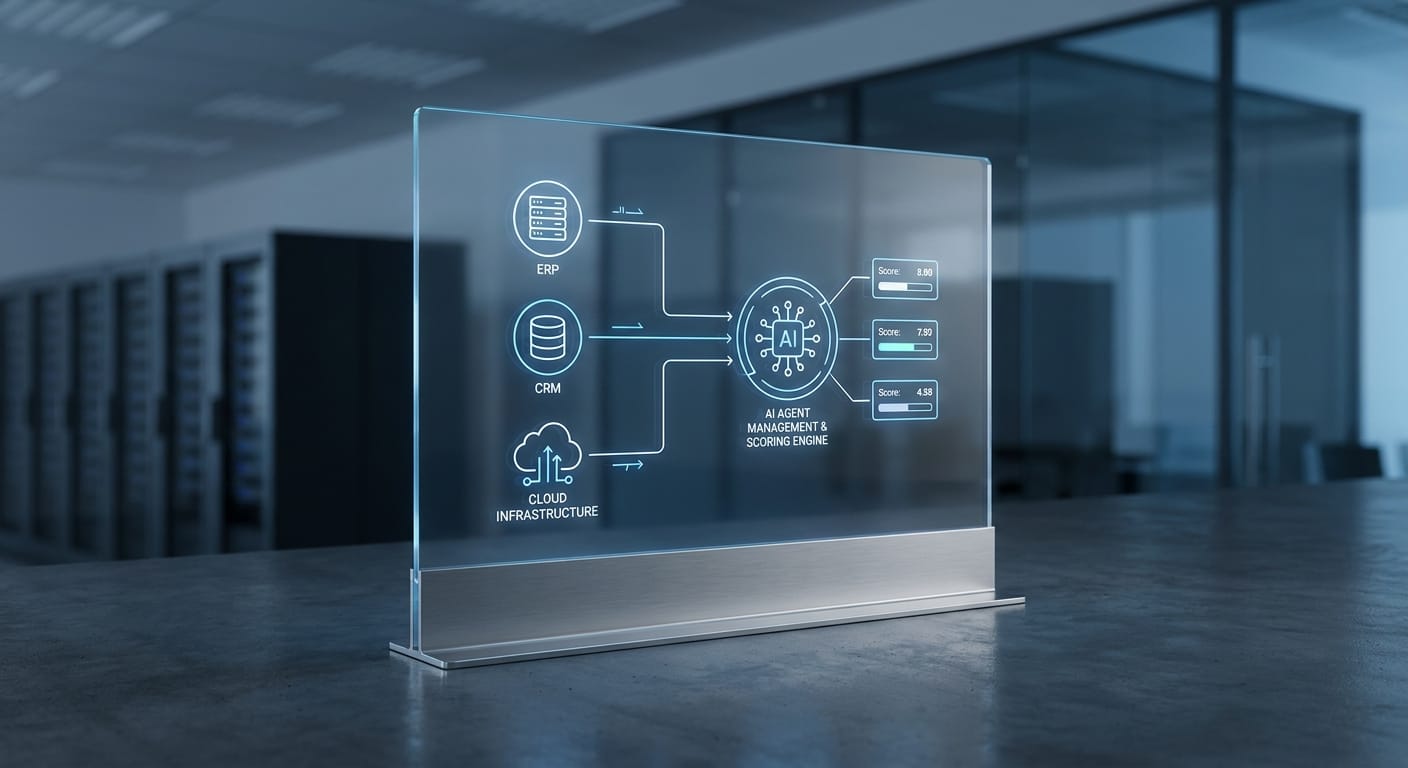
The Operational Triad: Governing Multi-Vendor Agent Estates
To eliminate this systemic exposure, operational leadership must replace fragmented ad-hoc oversight with an architectural discipline I call the Operational Triad. When I managed automation rollouts across processing facilities in the Khalifa Industrial Zone Abu Dhabi, our team watched unmonitored robotic process pipelines drift away from production baselines because we lacked cross-vendor visibility. We learned through expensive post-mortem reviews that an agent without lifecycle boundaries inevitably degrades business logic.
According to analytical insights from Gartner, organizations lacking cross-platform AI governance will experience twice as many operational failures and security breaches from rogue autonomous workflows through 2027. If an autonomous worker possesses write-access permissions to enterprise ledgers, it demands the same rigorous inspection protocols historically reserved for safety-critical industrial programmable logic controllers.
An autonomous agent deployed without a designated human owner, a concrete operational KPI, and an automated sunset timestamp is technical debt operating with direct database execution permissions.
The Operational Triad mandates that before any autonomous script, language-model pipeline, or agentic loop enters production, it must fulfill three uncompromisable criteria within a unified operational registry: mandatory assigned human ownership, real-time performance drift scoring, and programmatic decommissioning schedules. Cross-vendor management platforms must continuously crawl internal networks and cloud tenancy to register and score every active workload.
A GCC Industrial Case Study: When Ungoverned Agents Collide
Industrial enterprises throughout the Gulf region are committing billions toward advanced robotics and supply chain modernization, backed by sweeping research from McKinsey highlighting the Middle East as a primary frontier for industrial automation capital expenditure. Yet this aggressive push introduces complex dependencies when autonomous systems interact across infrastructure deployed on hyperscalers like AWS alongside legacy industrial mainframes.
Late last year, a regional logistics terminal in Jebel Ali experienced three consecutive days of unexplained dock congestion. Two autonomous scheduling agents-one provisioned in an enterprise ERP environment and another running inside a custom port logistics pipeline-began counteracting each other's load assignments. Neither tool possessed visibility into the other's operational queue, and because neither carried an assigned system custodian, the conflicting scheduling loops silently consumed processing cycles until physical container movement halted entirely.
The incident perfectly illuminated why enterprise architecture teams cannot evaluate autonomous performance in isolation. When native consoles report that individual agents are operating normally within their isolated sandboxes, those tools remain blind to systemic friction created at integration seams. Cross-platform estate management tools identify these algorithmic collisions by examining real-time data flows, operational latencies, and transaction reversals across enterprise boundaries.
The Executive Action Plan: How to Tame Your Agent Fleet Today
Regaining control over your organization's expanding AI perimeter requires decisive programmatic governance rather than further platform procurement. You do not need more models; you need a structured operational mechanism to police the models currently running in your production clusters. The following four-stage strategy provides the exact framework enterprise engineering teams must execute immediately.
1. Run a Unified Autonomous Discovery Audit
Direct your cybersecurity and cloud engineering teams to initiate network discovery protocols to locate every active autonomous pipeline, scheduled orchestration script, and conversational copilot across your infrastructure. Categorize these processes into an enterprise inventory that documents the underlying foundation model, hosting environment, credential access level, and active data connections.
2. Institute Explicit Operational Custodianship
Enforce a strict policy across your technology architecture: any agent lacking a validated, human business owner within the centralized registry is demoted to read-only status and subsequently decommissioned. Custodians must accept formal responsibility for the agent's behavior, algorithmic drift, and output veracity.
3. Implement Automated Performance Scoring
Establish automated telemetry thresholds that evaluate autonomous routines against clear key performance indicators. If an agent's confidence metrics decay, if hallucination markers breach acceptable variance, or if execution expenses scale beyond economic viability, the cross-platform governance layer must automatically isolate the agent for human review.
4. Hardcode Expiration Timestamps
End the era of infinite runtime lifespans for autonomous enterprise software. Require developers to encode explicit expiration dates into deployment metadata. When an agent reaches its sunset deadline, it must undergo automated operational re-certification before receiving an extension, ensuring that dormant or abandoned software components are scrubbed from your estate.
The transition from speculative experimentation to disciplined operational stewardship separates enduring enterprises from organizations vulnerable to algorithmic failure. How many untracked autonomous agents are executing tasks inside your operational perimeter right now, and what specific step will you take with your engineering leads this week to discover them?